

Deepwater Rice - investigations into the yellow stem borer in Bangladesh - 12 - 1982 research cont. |
| Several instances were found of S. incertulas larvae actively feeding in the fourth and fifth internodes down from the growing point, or
apex, of the stem. In no case had this led to obvious interruption of the
xylem flow to the apex, as in all instances the xylem tissues were stained
above the feeding damage. Even when larval feeding occurred in the
internode immediately below the terminal internode the flow to the upper
xylem was not interrupted and the panicle appeared to be normal. Feeding
in the internodes rarely was found to have penetrated as far into the
parenchyma as the inner ring of vascular bundles. Even when this had
occurred, disruption of conduction was limited to a few of the many
bundles. In one instance, a live pupating larva was found with
accompanying pronounced feeding damage to the inner ring of vascular
bundles, but the outer ring remained intact, with its xylem flow
uninterrupted. An example is shown right.
At the nodes, the vascular tissue appeared to form a dense continuous ring connecting all the incoming bundles from the internode. The nodal septum was unstained and was made up solely of undifferentiated ground tissue with no vascular tissue. Passage of larvae through the nodal septum (as below, node viewed lower side uppermost) was not found to have affected disruption of conduction or to have led to obvious reduction in growth above the penetrated node. 
Evidence of larval feeding earlier in the season was shown in several stems in which the lower part, at least one internode, had died (e.g. bottom of the stem on the right). This death, however, had not led to stem breakage as the silicaceous fibrous tissue had remained intact and the stems, therefore, remained anchored to the soil. |  |
| Deadhearts and whiteheads (see earlier) In some instances, especially in the early season, deadhearts are found. In these, the damage was due to small, first- or second-instar larvae which, after boring down between the flag leaf sheath and the stem, had entered just above the top node. The larval feeding had cut a ring right around the narrow apical stem, almost severing the stem. The result, shown right, was a total interruption of the vascular system and death of the apex - hence the deadheart. Later in the season, examination of many whiteheads showed just this near excision of the apical stem (below left). It was not uncommon at that time also to find two or more small instar larvae in a single stem (below right). | 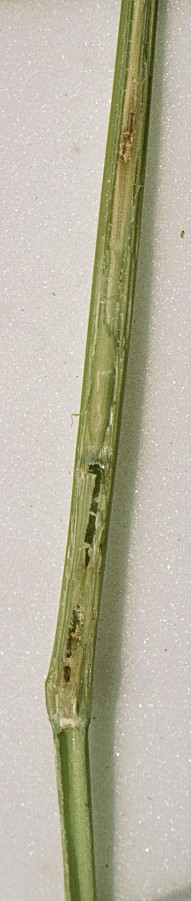 | |
 |  | |
 1982 research cont. - DWR anatomy summarised
| ©2000 - Brian Taylor CBiol FIBiol
FRES 11, Grazingfield, Wilford, Nottingham, NG11 7FN, U.K. Visiting Academic in the Department of Life Science, University of Nottingham |
href="\dwr\ysb10a.htm"