

Deepwater Rice - investigations into the yellow stem borer in Bangladesh - 15 - discussion cont. |
If the "infestation equals damage (i.e. crop loss)" is correct then one would expect season to season variations in levels of stem borer incidence to be directly reflected in the ultimate source of yield - the number of panicles and possibly the number of filled grains on each panicle. So what is the evidence?
Data obtained in six consecutive seasons by the ODA-BRRI project in Bangladesh are given in Table VII (unpublished results from project records and project reports to BRRI annual review meetings). As can be seen, the drop in stem density (tillers/m²) was of the same order in all six years, but in two of the years, 1979 and 1982, there were no great numbers of stem-borers until the late season. In 1982, moreover, weekly counts of tiller numbers showed that a decline set in before the onset of flooding and continued at an even rate right through to harvest.

These results are even more vivid in graphical form
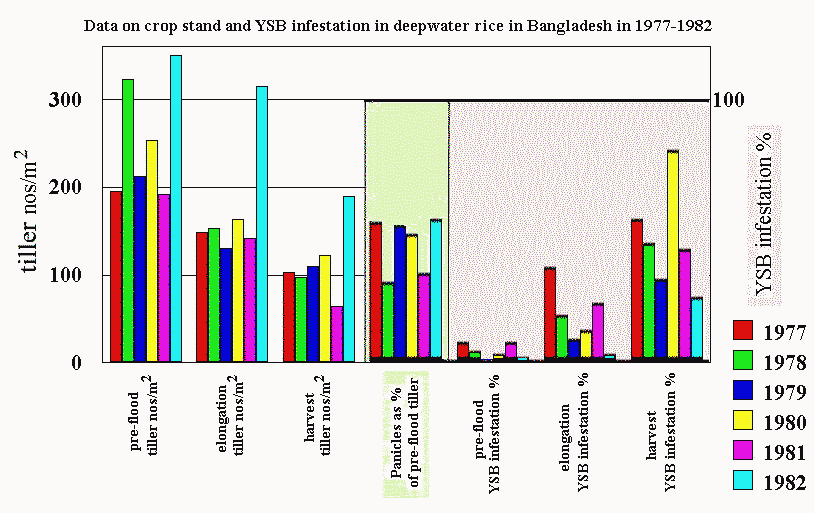
Islam (1990) presented further data from 1983 to 1985, showing the usual pattern of decline in tiller numbers, and stated also that stem borer damage was low up to September except in 1984. Catling & Islam (1995), apparently drawing on the earlier report by Catling (1981), show the borer populations in 1977-80, commenting specially on the very low larval numbers in 1979 and how only 5% of stems were damaged. However, they gave no information on numbers of healthy tillers apart from mentioning that 'there is a normal decline in plant stand during the flooding period'.
Singh et al. (1988) reported studies on stem borers in deepwater rice in Bihar, India. Field surveys showed stem infestation averaging 51.2% (range 36-64%) and whiteheads averaging 10.3% (range 10-44%). They did no statistical analysis, but (by extrapolation from their detailed table) there was no correlation between stem infestation and whiteheads (e.g. infestation 56% and whiteheads 4%; infestation 52% and whiteheads 44%; infestation 60% and whiteheads 4%; infestation 64% and whiteheads 25%). Screening of 92 DWR land races in 1985 did show some increase in the average number of larvae and average whitehead incidence with increasing infestation; but even 81-100% infestation gave only 10.2% whiteheads, whereas 21.0% infestation gave 6.8% whiteheads.
Shepard (1990) described attempts to simulate damage by S. incertulas in the high yield conventional rice variety, IR36, by cutting and removing 15 and 30% of the tillers at 50, 69 and 84 days after seeding. The early-season detillering had little or no effect on resulting yields but detillering at high levels during panicle initiation and grain-fill stages significantly reduced yields. Similar work on another high yielding variety, IR64, also showed that early season defoliation did not affect yield. In these varieties, however, there is no growth stage which is directly comparable to the mid-season elongation stage of deepwater rice.
 continue
| ©2000 - Brian Taylor CBiol FIBiol
FRES 11, Grazingfield, Wilford, Nottingham, NG11 7FN, U.K. Visiting Academic in the Department of Life Science, University of Nottingham |
href="\dwr\ysb12.htm"