


Deepwater Rice - investigations into the yellow stem borer in Bangladesh - final results from 1981 |
These results and the conclusions were first published by Taylor (1988)
To reiterate,eleven insecticides, supplied by their manufacturers, were tested in a replicated trial (three replicates), with an unsprayed control treatment. At Bastia, Manikganj, an area of 90 x 90 m within a field of the deepwater rice variety Digha, was divided into 36 plots, each 15 x 6 m. Four applications were made (13-14 May, 27-28 May, 10-11 June and 24-25 June), using a knapsack sprayer, at does rates recommended by the manufacturers and a spray volume of 600 litres/ha. Thirty-five stem samples per plot were taken for dissection on four dates pre-flood (the last being on 1 July when there was 30 cm of water in the field) and at harvest.
At harvest, on 12 November, three 1-m² crop-cuts were taken from each plot. from them, panicle numbers, panicle weights, grain weights and yield were measured. the results are presented in Table II.
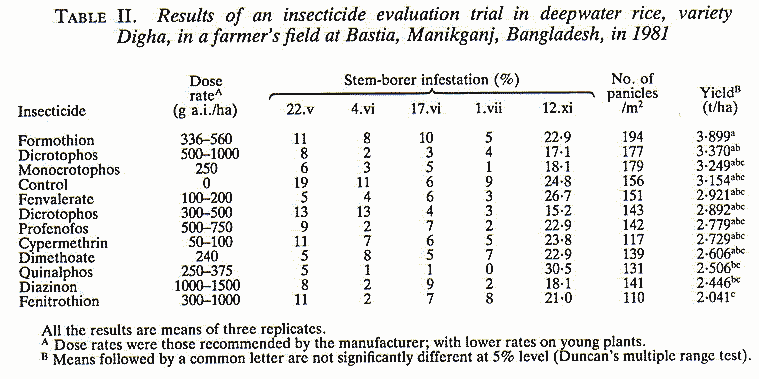
A one-way analysis of variance showed no significant variation between treatments; in part, this appeared to be due to soil heterogeneity. A two-way analysis of variance, performed after arranging the treatment data in blocks (viz. Block 1 with the highest values in each treatment, Block 2 with the median values and Block 3 with the lowest values) showed significant variations at the 1% level between blocks and between treatments. A Duncan's Multiple Range Test showed that the fourth ranked treatment was the unsprayed control. Only formothion appeared to give a markedly better result in terms of yield than the other treatments, and three products, quinalphos, diazinon and fenitrothion, gave markedly poorer results.
Assessment of the efficacy of the treatments according to the infestation by stem-borers did not prove meaningful.
Analysis of the data on panicle numbers per square metre (mean 148.4, s.d. ±36-52, C.V. 24.65%), panicle weights (mean 2.72 g, s.d. ± 0.368, C.V. 13.50%) and grain yield (mean 288.3 g/m², s.d. ±73.16, C.V. 25.37%) showed that there was no correlation between panicle numbers and panicle weights (r = 0.035), but there was a highly significant correlation (r = 0.93, P<0.01) between panicle numbers and grain yield.
Field trials carried out at four widely separated sites by the project agronomist were assessed to determine borer infestation before flooding and at harvest. The results obtained for 7 of the 20 varieties evaluated in a trial at Daudkandi on the Meghna floodplain are shown in Table I.
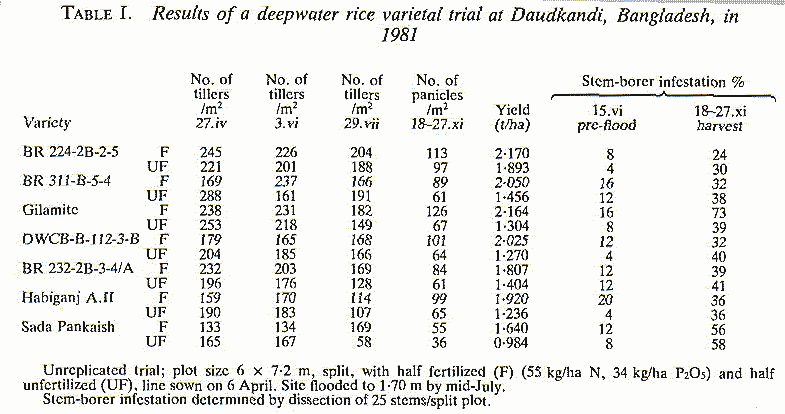
At this site, pre-flood infestation levels ranged from 0 to 32% but, in general, the numbers of deadhearts and infested stems in the fertilized plots were double those in the unfertilized plots. At harvest, there were no great or consistent differences in stem infestations, which ranged from 24 to 73% between the fertilized and unfertilized areas. The overall findings were that pre-flood infestation levels below 24% appeared not to affect yield, and the same was true of infestation levels below 42% detected at harvest.
At one site, near Narshingdi on the Meghna floodplain, major yield losses were complained of by farmers. A crop-cut from one farmer's field showed 83% infestation, and in two trial plots infestation levels were 64 and 80% in harvested stems.
A total of 100 deepwater rice plants was sampled at harvest from a farmer's field. Stems were dissected, and the position of any infestation was recorded. Grain sterility was assessed for each panicle, and panicle weights were determined.
One or more nodal tillers were found on 33% of the plants. Five per cent of the main stems were grossly damaged and rotten, each of them having been badly infested by borer larvae. Panicles on infested and uninfested main stems were similar in weight. A significant panicle weight difference occurred between basal (main stem) and nodal tillers.
The relations between grain sterility, panicle weight or mean grain weight and the position of the infestation were examined, but none of the relationships was significant. The highest grain sterility or number of whiteheads or both were associated with infestation in the terminal internode. The data showed that infestation in the immediately lower internodes also caused some increase in grain sterility, but the low sample numbers precluded detailed determination of whether there was a straight line relationship or if the slope of the relationship changed abruptly between the terminal internode and the third internode.
So when planning the 1982 programme, I felt pretty sure the question posed by the 1979 review team over the issue of whether or not YSB larval feeding causes ' damage' in an economic sense ought to be given high priority in 1982.
 1982 research
| ©2000 - Brian Taylor CBiol FIBiol
FRES 11, Grazingfield, Wilford, Nottingham, NG11 7FN, U.K. Visiting Academic in the Department of Life Science, University of Nottingham |
href="\dwr\ysb5.htm"