


Deepwater Rice - investigations into the yellow stem borer in Bangladesh - 9 - 1982 research continued |
| Data were obtained to evaluate the correlation, if any, between the extent of stem-borer infestation and crop yield in project agronomy trials. The five factorial trials (listed below in Table IV, that at Narshingdi is shown right early in the flood period) were assessed for infestation before flooding and at harvest. Other trials were assessed only at harvest. The sample size for each experimental plot was 25 stems, and a total of over 25,000 stems was dissected, requiring some 1250 man-hours of work. |  |
Factorial trials
The level of infestation before flooding (around 2-5%) was too low to warrant any calculation of the correlation coefficients for infestation and yield. The results obtained at harvest from each of the sites, are shown in Table IV.

There were eight randomized complete blocks at each site. The correlation between yield and infestation was examined for both of the rice varieties at each site. In only one instance, for the variety Ejuli Digha at Dubail, was there a significant correlation between infestation and yield. This was positive, indicating that the higher infestation gave a higher yield.
Transplanted variety trials
Three sites, Dubail, Rajbari and Narshingdi, with nine varieties and four replicates at each site, were sampled. The results are summarized in Table V.
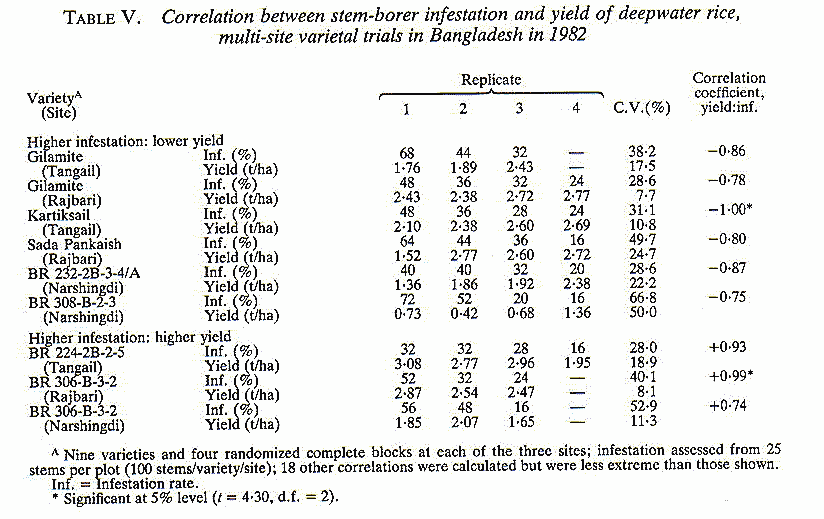
The mean infestations for the sites were 38.5, 36.2 and 36.0%, respectively. Only one variety, Gilamite, showed a significant correlation between the collective data for infestation and yield from all three sites, with a negative correlation (r = -0.69, t = 3.018, t at 5% level = 2.23, d.f. = 10), indicating that a higher infestation gave a lower yield. Of the 27 correlations for the nine varieties at each of the three sites, nine correlations were reasonably strong but only two were significant; the variety Kartiksail at Dubail (r = -1.00) and the variety BR 306-B-3-2 at Rajbari (r = 0.99 at 5% level, t = 4.30, d.f. = 2).
Four fertilizer response trials, laid down to evaluate a range of agronomic practices (fertilizer types, levels and timing, seed rates, seed treatments and mixed cropping) and using different varieties, were sampled. Forty correlation coefficients were calculated for yield : infestation (in the various treatments and site means); only two correlations were significant, both being positive.
The main constraints on the interpretation of the results from agronomy trials were first, that the yields were site- or field-dependent to a very high degree, and second, that there was very high variability in the levels of borer infestation (C.V. for mean infestation averaged around 40% in all the trials), but it was not feasible to sample more than 25 stems from each plot. that is less than 1% of the total.
 1982 cont. - YSB and grain filling
| ©2000 - Brian Taylor CBiol FIBiol
FRES 11, Grazingfield, Wilford, Nottingham, NG11 7FN, U.K. Visiting Academic in the Department of Life Science, University of Nottingham |
href="\dwr\ysb8.htm"