The History of the Parish Church
of St. Mary the Virgin, Nottingham
St. Mary's Nottingham, two Williams and a cross pomeé - continuation
The "Votive Crosses"
Around 1937, J. Holland Walker, then
churchwarden, wrote a manuscript guide to St. Mary's (copy held in the
Church). Some four years later, with a few small amendments, this appeared
in printed form. My attention was captured by his mention that on the
fifth pier from the west, in the south arcade, is inscribed "a
small cross with its arms terminating in pellets. This may be a mason's
mark, but it is strangely like the wellknown Crusaders' marks at
Winchelsea".
Holland Walker made no further comment on this cross and the current,
although somewhat dated, Guide Book (Peters, 1974) has no mention of any
marks. An earlier but undated leaflet (ca. 1930?) also mentions "certain
curious little crosses, which if they are not masons' marks, are votive
crosses commemorating some vow or pilgrimage", on the same pier.
Although he does not seem to have known it, Holland Walker's romanticism
of a Crusader's Cross would indeed go well with the now unearthed fact of
the Crusader Knight, Sir William Neville, being a sponsor of the new St.
Mary's.
Going back a few years, one finds that Gill (1916) has an illustration
(right) showing what he noted as being masons' marks from St. Mary's, but
without giving any details of their locations within the church.
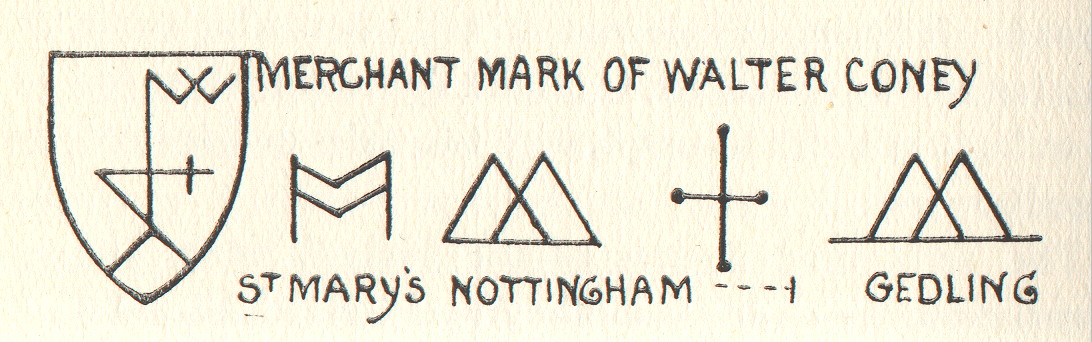 One of those marks was a pelleted cross. G.H. Cook (1954) wrote - "Reminiscent
of the early Perpendicular work at Gloucester cathedral are the transepts
of the noble church of S.Mary, Nottingham". In the same work, he
wrote also - "Curious little designs known as banker's marks are
often to be found on the piers in some parish churches. The marks,
including the initial letters of names were incised by the men who shaped
the stones on the bench or banker...... Masonry was an expensive item in
mediaeval building and a mark or an initial letter was a sure means of
identifying a craftsman guilty of faulty or scamped work..... On the stone
work of many churches appear graffiti that cannot be attributed to masons.
In particular there are the so-called votive crosses, said to have been
scratched by people about to make a journey who pledged themselves to
present a thank-offering to the church on their safe return".
Chamberlain (1957) noted that masons' marks, which at one stage were
believed to have "mystic purposes", usually are on plain stone
or simple carvings and rarely on major sculpture. This he attributed to
the fact that major pieces could usually be identified by fellow masons
from the quality and style alone.
One of those marks was a pelleted cross. G.H. Cook (1954) wrote - "Reminiscent
of the early Perpendicular work at Gloucester cathedral are the transepts
of the noble church of S.Mary, Nottingham". In the same work, he
wrote also - "Curious little designs known as banker's marks are
often to be found on the piers in some parish churches. The marks,
including the initial letters of names were incised by the men who shaped
the stones on the bench or banker...... Masonry was an expensive item in
mediaeval building and a mark or an initial letter was a sure means of
identifying a craftsman guilty of faulty or scamped work..... On the stone
work of many churches appear graffiti that cannot be attributed to masons.
In particular there are the so-called votive crosses, said to have been
scratched by people about to make a journey who pledged themselves to
present a thank-offering to the church on their safe return".
Chamberlain (1957) noted that masons' marks, which at one stage were
believed to have "mystic purposes", usually are on plain stone
or simple carvings and rarely on major sculpture. This he attributed to
the fact that major pieces could usually be identified by fellow masons
from the quality and style alone.
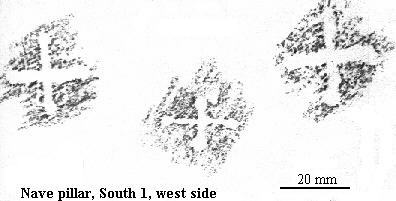 My
search for mason's marks started by locating Holland Walker's "cross"
on the South arcade pier. To my surprise at that time, as the figure
shows, I found that there are three such crosses close together on the
same, west face, of that pier (which I prefer to denote as S1, being in
the south aisle and the first to the west of the crossing under the
tower). Examining other piers revealed a cross on the east face of pier
N1. The crosses are all the same size, are very clearly inscribed,
possibly even stamped on, and are of the form known in Christian symbolism
as a "button cross" (Liungman, 1991) or "cross
pomeé". The latter is a traditional emblem of St. Michael,
the Archangel (Harl. ms. 5285, British Museum, has this in red on a silver
field). Then, and quite unexpectedly as I was not searching, I came upon
another button cross on a section of the moulding above left of the east
door from the north transept to the "Chapter House". The
moulding itself is a section of a prominent band of concave sill moulding
which runs in an essentially unbroken line right around the inside of the
walls from the northeast tower pier to the southeast tower pier.
Ironically, this particular section survived being removed, cut down in
size, and replaced alongside a section of fresh stone (sill cum
architrave) when a pair of new doorways out of the north transept were
made in 1940. So now the evidence had swung towards the button cross being
a mason's mark and not some travellers or Crusaders votive cross.
My
search for mason's marks started by locating Holland Walker's "cross"
on the South arcade pier. To my surprise at that time, as the figure
shows, I found that there are three such crosses close together on the
same, west face, of that pier (which I prefer to denote as S1, being in
the south aisle and the first to the west of the crossing under the
tower). Examining other piers revealed a cross on the east face of pier
N1. The crosses are all the same size, are very clearly inscribed,
possibly even stamped on, and are of the form known in Christian symbolism
as a "button cross" (Liungman, 1991) or "cross
pomeé". The latter is a traditional emblem of St. Michael,
the Archangel (Harl. ms. 5285, British Museum, has this in red on a silver
field). Then, and quite unexpectedly as I was not searching, I came upon
another button cross on a section of the moulding above left of the east
door from the north transept to the "Chapter House". The
moulding itself is a section of a prominent band of concave sill moulding
which runs in an essentially unbroken line right around the inside of the
walls from the northeast tower pier to the southeast tower pier.
Ironically, this particular section survived being removed, cut down in
size, and replaced alongside a section of fresh stone (sill cum
architrave) when a pair of new doorways out of the north transept were
made in 1940. So now the evidence had swung towards the button cross being
a mason's mark and not some travellers or Crusaders votive cross.
Over a period of time, my list of button cross locations grew quite
remarkably. As the search progressed a range of other marks and graffiti
were alighted upon, often with a sighting owing much to the changing
natural light patterns in this great house of light as the seasons passed.
Of the button crosses more later but one fact seemed clear, they are all
on some of the smoothest quality stone in the whole building. A second
mason's mark, the "tristar" (my name for it) was located
on stone work which clearly shared the characteristics of that with button
crosses. Figure 1 maps the horizontal position of the locations of the
button crosses and tristars.
Figure 1 - Click thumbnail photos for larger
illustrations

The thumbnail photographs provide an indication of the extent of the
variation in vertical positions and the forms of masonry now known to have
these two ancient marks. For record purposes, a collection of other
mason's marks and graffiti are shown in the Appendix
(as with the button cross and tristar examples in Figure 1, most of these
are "brass-rubbings").
To return to the stonework bearing a button cross or a tristar, and
there is never more than one mark on an individual piece of masonry,
perhaps the most exciting find was that alongside King Richard's Head. On
the right of the ancient and original doorway in the north aisle, leading
into what most think was a Chantry House, this sculpture, with its paired
Queen on the other door jamb, has to be one of the most important pieces
of carving in the whole church. Although slightly damaged, it very closely
resembles the paintings, most apparently based on one in Westminster
Abbey, of which examples are shown in the Figure.
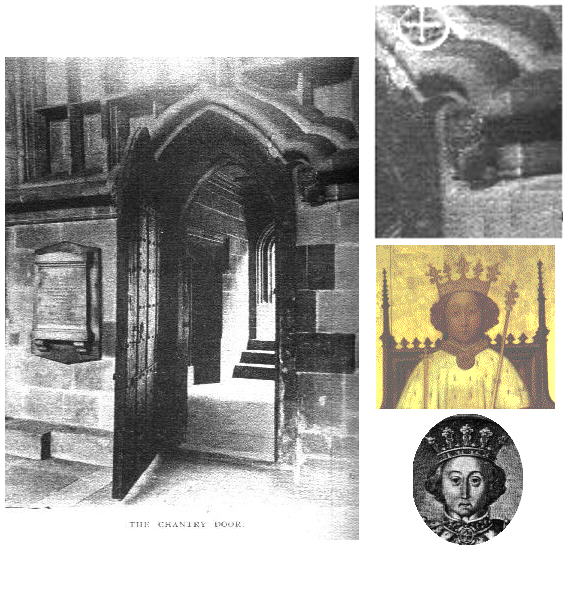
The original of the lower image is in Henry Holland's Basiliologia
of 1618 (reproduced in Du Boulay & Barron, 1971). The crown, the
hairstyle and the facial characteristics of the sculpture all match the
paintings. The stone bearing the head is a massive single piece which
encompasses the whole angle, including the hood moulding and here is a
button cross. The sister stone with Queen Anne of Bohemia upon it has no
mark.
What is worth noting here is that the hood moulding of the interior of
the south porch is identical in form, albeit larger in scale, to that of
the old north door. Surprisingly, the previous descriptions, even those of
Close (1866) and Gill (1916) do not remark on this similarity, let alone
note that there probably were heads on the two angles of the south porch.
The evidence comes from the very crudeness of the stone surface, with
clear chisel marks where erasure of former embellishment has taken place.
The remains of effaced angels on the east walls of both transepts provide
further evidence for such brutality in the Reformation or Puritan periods.
The various locations of the button cross and tristar, moreover tell us
much about the period of construction of the present building.
In addition to those already described, Figure 1 shows the site
of others on the shaft of nave pier N1, the windows in both transepts
(mullions and frames), and the large corner stone next to the Smith
monument in the south aisle. Those on window frames and mullions are all
on masonry which is embellished by a narrowly separated pair of decorative
lines. This double line is missing from most, if not all, replacement
mullions and frames. The finding, the last for me, of a button cross on
the window above left of the 1942 north aisle doorway leading to the Choir
vestry, denotes a continuity of building work which embraces the two
transepts and both aisles. Even allowing for the extensive replacement of
original masonry, especially in the south aisle and south wall of the
south transept, it seems a solid conclusion that Gill's (1916) thinking on
the termination one bay west of the south porch is correct. The position
of that likely western wall is also shown on Figure 1.
The suggestion of a phased building over the earlier church, however, is
refuted by the inclusion of the nave pillars (remembering that the tower
piers were wholly rebuilt in 1845-8) in the masonry from the bench of no
more than two masons working simultaneously. I have not been able to
closely examine the clerestory but the key double line decoration can be
seen in a few relics of the original frames.
 Continue
References
Continue
References  Return to History Introduction
Compiled by Brian Taylor, published September 2000
stmarys/2ws&anx7.htm