The History of the Parish Church
of St. Mary the Virgin, Nottingham
St. Mary's Nottingham, two Williams and a cross pomeé - Conclusion
The date of the new foundation
and rebuilding
As already noted, the King's head on the north
door closely matches the known images of Richard II. The clarity of the
carving suggests it was done from life and Richard was in residence in
Nottingham often enough and for long enough for that to have happened. His
being deposed from the monarchy in 1399 gives a quite precise dating,
especially as one cannot envisage such a memorial being installed during
the reign of his usurper, Henry IV, or in the rest of the Lancastrian
period (1399-1485). A reasonable date for the carving, with the head being
that of a young adult, is around the time of Richard achieving "political
maturity", as he himself proclaimed, in May 1389, when he was 22
years old. From the dates evidenced by Saul (1997), it may have been
earlier, 1387, when Richard was in Nottingham for much of the Spring and
again in the Autumn, or, more likely in light of subsequent events, in
1390, when the King, Chancellor and Council were all in Nottingham.
The Date of the Foundation
From the carvings and lost armorial glass, thus, the date of foundation
of the present church appears to be between 1382 and 1394, from the dates
of the marriage of Richard II and Anne. This can be tightened to after
1388 when Thomas de Arundel became Archbishop of York; to before 1391,
when William Nevill, the Constable of Nottingham Castle died; to 1389-90,
when the main characters were all in Nottingham at some time; and,
perhaps, even to 1389 when Richard attained maturity.
The Purity of Style
As mentioned earlier, one might conclude that St. Mary's is plain, in
lacking the, date-wise, later examples, which have the rectangular
panelling with decorative in-filling. However, as Cox wrote - "we
still hold strongly that there is more, at all events for the Churchman,
to admire in Perpendicular work - for religion should above all be orderly
and disciplined in its expression - than in the sensuous exuberance of the
Decorated Period". From that one can see how the ascetic Lollard
knight, Sir William Neville, could have motivated the purity of style seen
at St. Mary's.
Pre-dating the Winchester Perpendicular
Orange (1840, 508) argued for St. Mary's being built about "1409,
which would be five years after the nave of Winchester Cathedral was
built, and while the perpendicular style retained its original purity",
pointing out that there was nothing at St. Mary's of the decorated English
style "except in the new buttresses, which in a perversion of
taste were added to the south transept, in 1818". If, however, he
was correct in writing of the nave of Winchester being built in, or rather
altered to, the Perpendicular style, with panelling strikingly displayed,
by William of Wykeham as a "work, which appears to have occupied
the last ten years of his life", i.e. in 1394-1404, St. Mary's
may well be a precursor to the development at Winchester.
The Master Builder
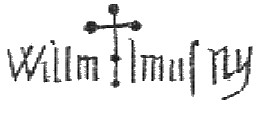 Speculatively,
if the builder/mason was William Swanlond (as employed by Nevill at the
Castle, see earlier), it may be significant that there is a place named
Swanland, just to the west of Hull, and that would suggest he could have
learnt his trade at the local Cathedral. That, of course, matches Harry
Gill's opinion as to the likely master builder as being one with knowledge
of York Minster, much of which was built contemporaneously with St.
Mary's. Even more speculatively, chancing upon Hine's illustration of the
signature of William I (right), which has a button cross (perhaps) above
the main line, led me to wonder if the button cross symbolized the name
William. Perhaps that is too much of a guess but, as there seems to be
little or nothing written on mason's marks, it seems worth noting.
Speculatively,
if the builder/mason was William Swanlond (as employed by Nevill at the
Castle, see earlier), it may be significant that there is a place named
Swanland, just to the west of Hull, and that would suggest he could have
learnt his trade at the local Cathedral. That, of course, matches Harry
Gill's opinion as to the likely master builder as being one with knowledge
of York Minster, much of which was built contemporaneously with St.
Mary's. Even more speculatively, chancing upon Hine's illustration of the
signature of William I (right), which has a button cross (perhaps) above
the main line, led me to wonder if the button cross symbolized the name
William. Perhaps that is too much of a guess but, as there seems to be
little or nothing written on mason's marks, it seems worth noting.
The South Porch and Samon Tomb
The South Porch and the Samon, south transept, tomb canopy present an
enigma but it seems reasonable to accept that they represent the building
immediately prior to the great Perpendicular structure. Alternatively, it
may be that the south porch is the genuine relic and that the Samon tomb
canopy, which is integral with the south wall of the transept, simply
reflects a copying of the porch. Either way, the involvement of a very
wealthy merchant family in the funding of the new church makes sense,
especially if the additional commercial merit of keeping on good terms
with the obviously powerful Constable of the Castle is seen as a factor.
Dedication Day
Finally, Peters (1974) wrote "It is not known when this church
was dedicated. It used to be celebrated, according to the command of
Convocation in 1536, on the first Sunday in October". The Feast
of the Blessed Virgin Mary is the 8th September and, thus, that would not
have been a proxy dedication day. As a romantic speculation, Sir William
Neville died in October 1391. Perhaps, the dedication day was determined
as in memoriam for a brave Crusader.
 References Appendix
on Masons' Marks
References Appendix
on Masons' Marks  Return to History Introduction
Compiled by Brian Taylor, published September 2000
stmarys/2ws&anx8.htm