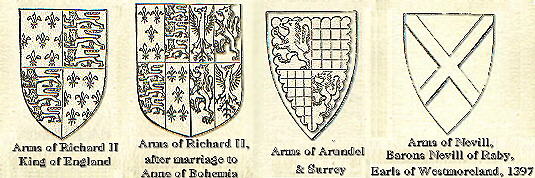
Among the names in Colvin (1963), was William Nevill, the Constable of Nottingham Castle. Suddenly, after over 130 years, the conundrum of the Arms of Nevill (Close, 1866) seems to be answered, as here is a Nevill in the right place and at the right time. The title "Constable" might suggest little more than a local administrator, perhaps with military significance but, in fact, William Nevill was a confidante of the king. Tuck (1973) described how Richard II developed and placed considerable reliance on the "chamber organization", with its core of officials playing an important part in government acting as links between the Royal council and the royal household. Among the members of the chamber was Sir William Neville (or Nevill), and he was given life custody of Nottingham Castle in November 1381 (cited from the Calendar of Pipe Rolls, 1377-81, p 277). Moreover, he was among the frequent attenders at the Council in 1389-90. The Records of the Borough of Nottingham have but two references to William Neville, in one he was appointed to a Commission which looked into the obstruction of the course of the River Trent at Colwick in 1383 (RBN I, 226), and the other was when he ordered legal action against the people of Bulwell for "owing 14d for chiminage of the Lord King" (RBN, I, 232).
Gillespie (1997) tells of "The two chamber knights, John Clanvow and William Neville, were members of that small and influential circle of Lollard knights found at Richard's court". These two had participated, as Crusaders, in the Duke of Bourbon's assault on Tunis, and "did not long remain in England after their return. They died within days of each other in the vicinity of Constantinople in October 1391, two of many Englishmen who died in the east during Richard II's reign in a continuing pursuit of crusading and chivalric ideals". From Saul (1997), one learns that "Sir William Neville, a close associate of Clanvow's, was a brother of Ralph Neville, the future Earl of Westmoreland, and Alexander, Archbishop of York, the king's close ally." Sir John Clanvow had previously been a knight of Edward III and also was attached to Richard's court from 1381. Both he and William Neville were closely connected with Lollardy, Clanvow indeed had written a religious tract, and, thus the court may have had a "distinctly radical religious atmosphere". The Lollards followed the ideas of John Wyclif and Saul tells us that "Lollardy was in the strict sense of the word a movement for 'reform': it sought not the destruction of the church but its regeneration on lines that corresponded to new attitudes of mind and accorded a new recognition to the laity. It was merely one manifestation, albeit an extreme one, of the ascetic, evangelical and anti-sacerdotal mood of contemporary lay piety".
In an Appendix, Saul (1997) lists expenditure records for the itineraries of Richard II. These show that the court was in Nottingham in 1380, 1385, 1387, 1390, 1392, 1396, 1397 and 1398. Looking at the time when William Neville was Constable, Richard stayed in Nottingham in 1385, between June 9-10 and August 25-8, and in 1387, four times - February 21-26, March 17, April 3-8, August 25-9 and September 9-11. Saul (in Gillespie, 1997, p 82) described how "throughout the middle and later years of his reign, Nottingham was the place that he favoured most after Westminster for the holding of councils and great councils"; and wrote of lengthy stays in 1395, 1396 and 1398, including 48 days in 1396. In 1387, Richard had held the second of his two meetings with the judges, answering questions on the rights and procedures of the crown.
The fourth coat of arms formerly to be seen in St. Mary's was that of Thomas Arundel (1353-1414). Interestingly, Arundel came to the forefront on the falling into disfavour of Alexander Neville. Alexander, William's brother, was a political appointee to the position of Archbishop of York who became renowned for the extortion of money from his See. Whether true or not, this led to his being banished into exile in a period of political upheaval in 1388. Arundel, another a political appointee from within the ranks of the aristocracy, was promoted from the bishopric of Ely to the higher post at York. He had however already been at court, as on 3 August 1381, at Nottingham, he had been granted restitution by the king for goods and chattels seized in Ely during the Peasants' Revolt.
Another member of the king's council, from at least 1383 to 1392-3, was Bishop Wykeham of Winchester, Bishop from 1367-1404 (Orange, 1840, 508; Saul, 1997, 253; Aston, 1967). In his article, Pace noted that the original builder or architect of the 14th Century, if there was any distinction at the time, was unknown, but quoted a suggestion (by Close, 1866) that it might have been William Wyneford (or Wynford), the designer of the nave of Winchester Cathedral, where he was the architect for William of Wykeham. By surrounding Norman columns with shafts of masonry and converting the arches into a pointed form, Wyneford and Wykeham created the perpendicular style still to be seen at Winchester (text and illustrations in Bussby, 1979). The arches spring from small column tops, to call them capitals would be too generous. In the spandrel, or angle of the arches, are small niches, as seen on the south wall below the clerestory at St. Mary's. The base of the tomb of William of Wykeham has small ogee arches and fluted column tops, similar to those on a larger scale in the south transept tomb at St. Mary's. Thus, a collective link between those who appear to have promoted the building of the new St. Mary's and the architectural style perfected in the church is revealed.
J. Charles Cox (undated) is another author providing a broad introduction to the styles and buildings materials of English Parish Churches. Curiously, although he did refer to St. Mary's it was in an odd comment of it being an example where the plan [apparently he meant due to the presence of the side aisles to the nave] "is almost, if not entirely reduced to a rectangular as at.... St. Mary's, Nottingham....". Scanning his examples of the Perpendicular Period, it is obvious that St. Mary's has to rank above almost all the churches which he chose as examples. As a negative, one might conclude that St. Mary's is plain, in comparison with the, date-wise, later examples, which have the rectangular panelling with decorative in-filling. However, Cox himself wrote - "we still hold strongly that there is more, at all events for the Churchman, to admire in Perpendicular work - for religion should above all be orderly and disciplined in its expression - than in the sensuous exuberance of the Decorated Period". It surely makes sense to lead on from that sentiment to see how the ascetic Lollard knight, Sir William Neville, could have motivated the purity of style seen at St. Mary's.
 Continue
References
Continue
References  Return to History Introduction
stmarys/2ws&anx6.htm