
SUBFAMILY MYRMICINAE - Genus Pyramica - subgenus Smithistruma
|
|
The Ants of
Africa SUBFAMILY MYRMICINAE - Genus Pyramica - subgenus Smithistruma |
| Genus Pyramica |
In Tribe DACETINI.
Bolton (1999) made a radical revision and had Smithistruma as a junior synonym of Pyramica Roger. However, for convenience, I retained Smithistruma as a subgenus of Pyramica and so kept the key.
Diagnostic Features - Antennae 4-segmented (former Miccostruma) or 6-segmented, antennal scrobes present. Mandibles relatively short, subtriangular, serially dentate, and concealed for most of their length by the very well developed, anteriorly projecting clypeus, which is fringed anteriorly and laterally by flattened hairs. Dorsum of head with fine scattered punctures, hairs absent except on clypeus. Dorsum of alitrunk, pedicel and gaster mostly shiny, with small, widely spaced punctures. Base of first gastric tergite with longitudinal striae. Sutures absent from dorsal alitrunk. Propodeum bidentate. Spongiform appendages of pedicel well developed.
Brown (1953g) reviewed the then known African species, his key
and descriptions are at  .
.
Bolton (1983) described how all known Afrotropical species inhabit the leaf litter and topsoil layers, usually nesting directly into the ground or in rotten wood. The feeding habits of genus members were described by Déjean (1985), including Smithistruma truncatidens feeding on entomobryomorph collembolans. No species was regarded as common (Bolton, 1983) and most were represented by only a few collections and those were of few individual workers. Collecting efforts using Berlese and similar funnel extraction techniques had greatly increased the number of known species; for instance prior to Bolton's revisionary work only eight African species had been described, afterwards there were 35 separable species.
Smithistruma species C and Smithistruma species F, listed from cocoa leaf litter, and Smithistruma species E, listed from soil under Euphorbia, at the Mampong Cemetery farm in Ghana (Room, 1971), are clearly the three species emarginata, hensekta and sharra (see below) but they are not separable from the information given by Bolton (1983). A further, presently unnamed, species was found by Belshaw & Bolton (1994b), in Ghana, four workers collected from leaf litter, under cocoa at Effiduase and Bunso.
Bolton (2000: 269-271) separated these into the following species
groups:
Key to subgenus Smithistruma workers from Africa (adapted from Bolton, 1983):
| 1 | Antennae with 4 segments | 2 |
| -- | Antennae with 6 segments | 8 |
| 2 | In full-face view, clypeus with a convex margin; pronotum with a median longitudinal carina and pronotal humeri each with a single flagellate hair | 3 |
| -- | In full-face view, clypeus with a concave margin; pronotum without a median longitudinal carina and pronotal humeri without flagellate hairs | 5 |
| 3 | 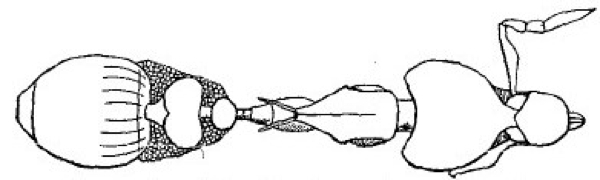 Clypeus broad, seen
in
full-face view expanded laterally far beyond the line of the outer
margins of the closed mandibles; clypeus without hairs; TL 1.2-1.3 mm;
uniform dull yellow to yellowish-brown Clypeus broad, seen
in
full-face view expanded laterally far beyond the line of the outer
margins of the closed mandibles; clypeus without hairs; TL 1.2-1.3 mm;
uniform dull yellow to yellowish-brown |
. |
| . |  |
Ivory Coast,
Ghana, Kenya,
Tanzania, Zimbabwe & South Africa - marginata |
| -- | Clypeus narrow; edges more or less parallel with outer border of closed mandibles; dorsum of clypeus with abundant short curved hairs | 4 |
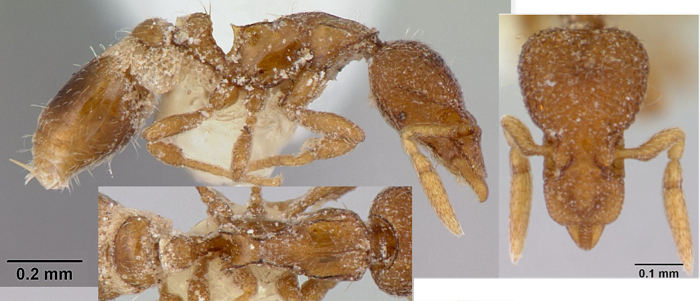
| 4 | 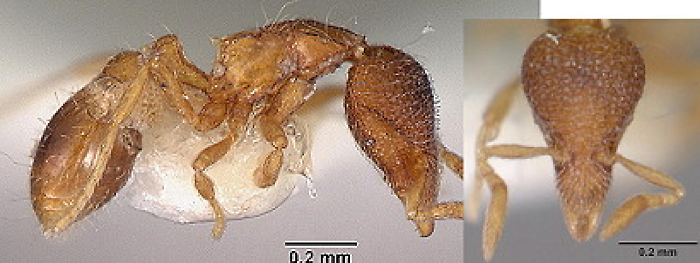 Pronotum sharply
marginate
laterally, dorsum unsculptured; head relatively broad and scapes
short; smaller, TL 1.7-1.8 mm, HL 0.42-0.46, HW 0.29-0.31, SL
0.18-0.20, PW
0.19-0.22; yellow to yellowish-brown Pronotum sharply
marginate
laterally, dorsum unsculptured; head relatively broad and scapes
short; smaller, TL 1.7-1.8 mm, HL 0.42-0.46, HW 0.29-0.31, SL
0.18-0.20, PW
0.19-0.22; yellow to yellowish-brown |
West Africa & Congo Basin - tacta |
| -- |  Pronotum not
marginate,
dorsum weakly sculptured; head relatively narrow and scapes long;
larger, TL
3.0 mm, HL 0.74, HW 0.38, SL 0.44, PW 0.30; colour medium-brown Pronotum not
marginate,
dorsum weakly sculptured; head relatively narrow and scapes long;
larger, TL
3.0 mm, HL 0.74, HW 0.38, SL 0.44, PW 0.30; colour medium-brown |
Cameroun - vodensa |
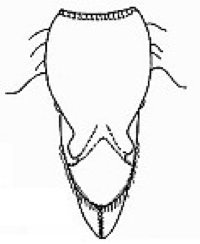
| 5 | 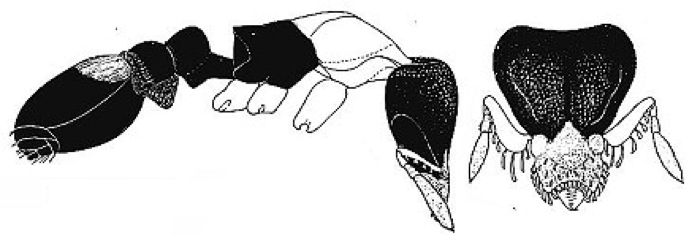 Entire body with
yellow and
black tiger stripes; TL 2.0-2.2 mm Entire body with
yellow and
black tiger stripes; TL 2.0-2.2 mm |
. |
| . | 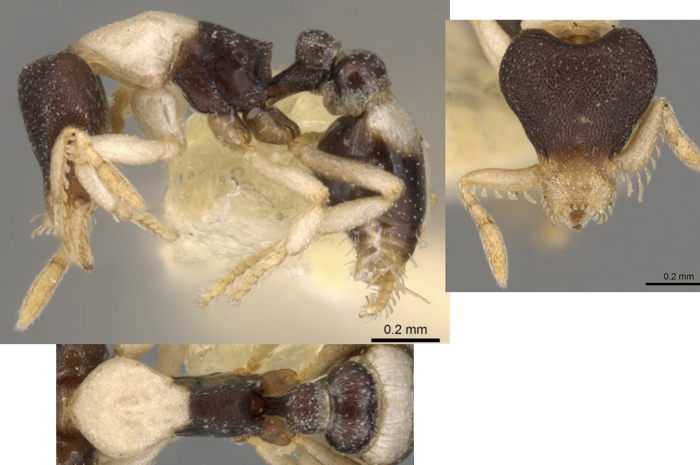 |
West Africa - tigrilla |
| -- | Body uniformly coloured | 6 |
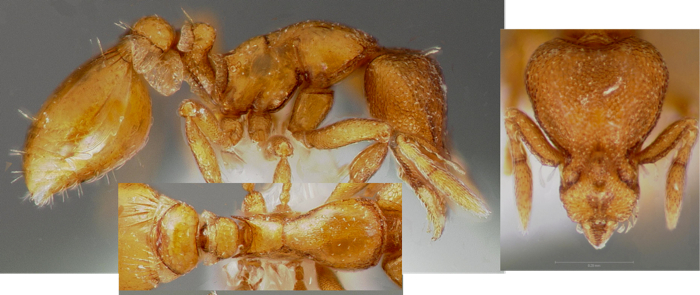
| 6 | 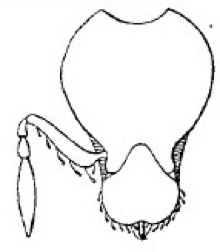 In profile dorsum of
head
with a pair of short erect hairs; 4-segmented antennae; TL 1.7-1.8 mm;
yellow to light brownish-yellow In profile dorsum of
head
with a pair of short erect hairs; 4-segmented antennae; TL 1.7-1.8 mm;
yellow to light brownish-yellow |
. |
| . |  |
Kenya,
Tanzania & Angola - [alternative name maxillaris] mandibularis |
| -- | In profile dorsum of head without erect hairs | 7 |
| 7 | 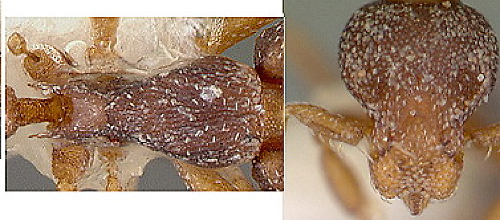 Anterior half of
clypeus
with a broad longitudinal depression filled with short scale-like
hairs; subbasal elbows of scapes extensively developed and angular;
pronotal dorsum with dense fine longitudinal rugulae or costulae; TL
2.0 mm; dark brown Anterior half of
clypeus
with a broad longitudinal depression filled with short scale-like
hairs; subbasal elbows of scapes extensively developed and angular;
pronotal dorsum with dense fine longitudinal rugulae or costulae; TL
2.0 mm; dark brown |
Ivory Coast & Ghana - fulda |
| -- | 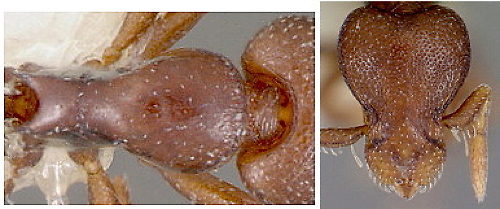 Anterior half of
clypeus
without an impression and that area without short scale-like hairs;
subbasal elbow of scapes evenly rounded and not angled; pronotal dorsum
smooth or faintly shagreened; TL 1.7-1.8 mm; dark yellow brown,
extremities orange Anterior half of
clypeus
without an impression and that area without short scale-like hairs;
subbasal elbow of scapes evenly rounded and not angled; pronotal dorsum
smooth or faintly shagreened; TL 1.7-1.8 mm; dark yellow brown,
extremities orange |
West Africa - ninda |
 |
Antenna 6-segmented | . |
| 8 | 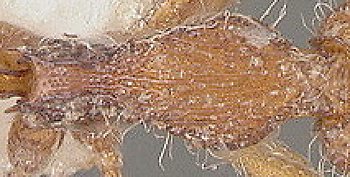 Dorsum of pronotum
extremely
coarsely sculptured with closely packed strong rugae or sulci giving a
very coarse overall appearance Dorsum of pronotum
extremely
coarsely sculptured with closely packed strong rugae or sulci giving a
very coarse overall appearance |
9 |
| -- | 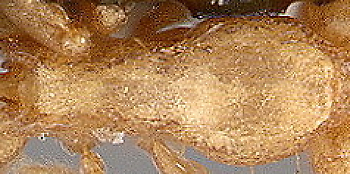 Dorsum of pronotum
smooth to
densely reticulate-punctate; may have feeble striate or very fine
superficial rugulae Dorsum of pronotum
smooth to
densely reticulate-punctate; may have feeble striate or very fine
superficial rugulae |
22 |
| . | Dorsum of pronotum coarsely sculptured | . |
| 9 | 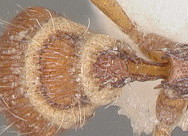 Disc of postpetiole densely
and strongly longitudinally costulate Disc of postpetiole densely
and strongly longitudinally costulate |
10 |
| -- | Disc of postpetiole smooth and unsculptured, or no more than uneven or feebly punctate | 12 |
| 10 | 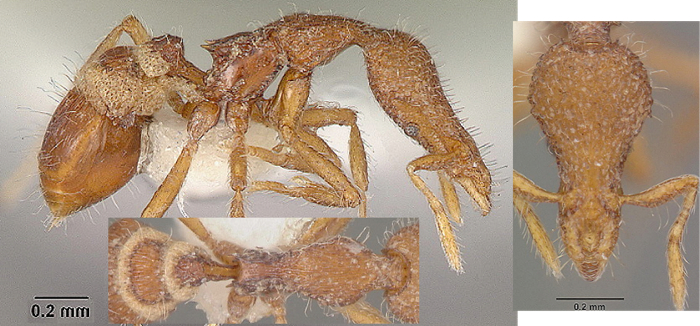 Head very long and
narrow
(CI 54-58), antennal scapes long (SI 73-78); TL 2.4-2.6 mm; medium brown Head very long and
narrow
(CI 54-58), antennal scapes long (SI 73-78); TL 2.4-2.6 mm; medium brown |
Ivory Coast & Ghana - minkara |
| -- | Head shorter and broader (CI > 60), antennal scapes shorter (SI 68-73) | 11 |
| 11 | 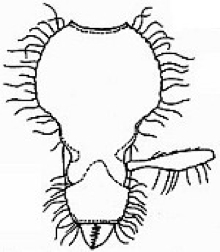 Disc of postpetiole
completely surrounded by dense spongiform tissue; transverse strips
complete; pronotum dorsum coarsely longitudinally rugose; TL 2.4 mm;
dark blackish-brown Disc of postpetiole
completely surrounded by dense spongiform tissue; transverse strips
complete; pronotum dorsum coarsely longitudinally rugose; TL 2.4 mm;
dark blackish-brown |
. |
| . | 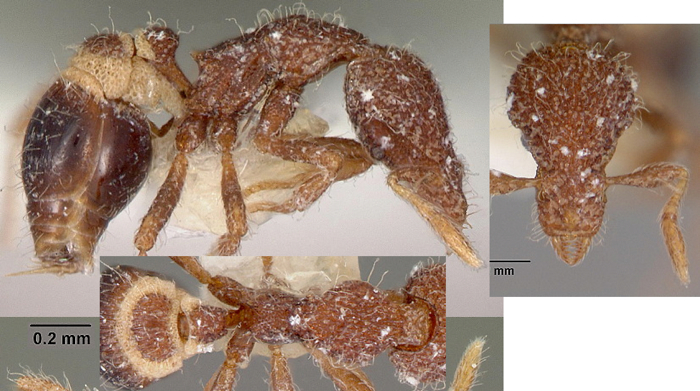 |
West Africa - enkara |
| -- | 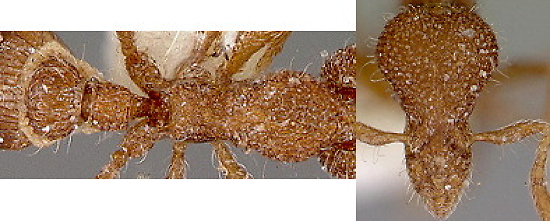 Disc of postpetiole
with
dense spongiform tissue only posteriorly and posterolaterally;
transverse strips interrupted medially; pronotum dorsum irregularly
reticulo-rugose; TL 2.4-2.6 mm; medium brown Disc of postpetiole
with
dense spongiform tissue only posteriorly and posterolaterally;
transverse strips interrupted medially; pronotum dorsum irregularly
reticulo-rugose; TL 2.4-2.6 mm; medium brown |
Tanzania & Zimbabwe - nykara |
| 12 | 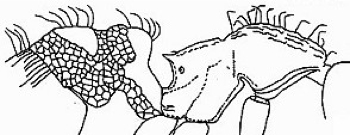 With alitrunk in
profile
metanotal groove distinctly impressed With alitrunk in
profile
metanotal groove distinctly impressed |
13 |
| -- | 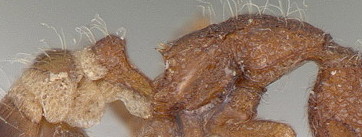 With alitrunk in profile
metanotal groove not impressed, dorsal outline continuous With alitrunk in profile
metanotal groove not impressed, dorsal outline continuous |
15 |
| 13 | 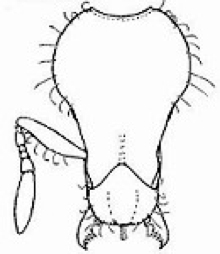 Posterior spongiform
margin
of postpetiole medially very deeply indented and reaching the margin of
the disc; TL 3.0 mm; medium brown Posterior spongiform
margin
of postpetiole medially very deeply indented and reaching the margin of
the disc; TL 3.0 mm; medium brown |
Zaïre - weberi |
| -- | 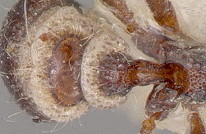 Posterior spongiform margin
of postpetiole medially very shallowly indented, clearly not reaching
margin of disc Posterior spongiform margin
of postpetiole medially very shallowly indented, clearly not reaching
margin of disc |
14 |
| 14 | 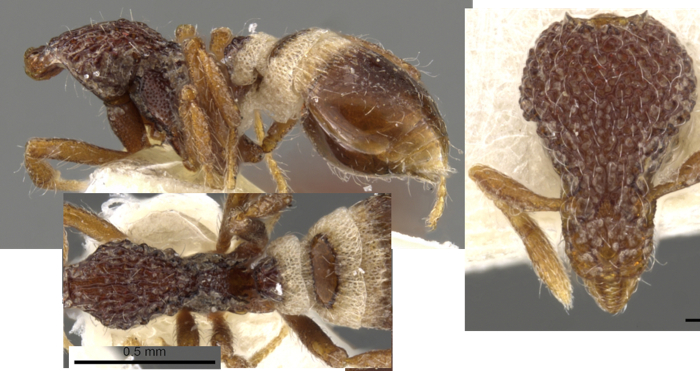 Dorsum
of head with hairs strongly forward-arched so as to almost or actually
touch surface; TL 2.6 mm; brown Dorsum
of head with hairs strongly forward-arched so as to almost or actually
touch surface; TL 2.6 mm; brown |
Cameroun - mekaha |
| -- | 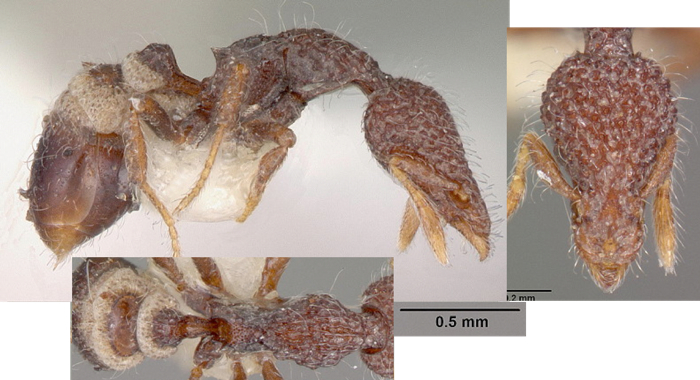 Dorsum of head,
especially
posterior half, with hairs which have the basal half to two-thirds
erect then apices sharply angled forward; TL 2.5-2.6 mm; dark brown Dorsum of head,
especially
posterior half, with hairs which have the basal half to two-thirds
erect then apices sharply angled forward; TL 2.5-2.6 mm; dark brown |
Cameroun - kerasma |
| 15 |
Dorsum of head behind clypeus with only fine soft looped or arched simple hairs | 16 |
| -- | Dorsum of head behind clypeus usually with fine hairs plus long, stout conspicuous hairs similar to those on the clypeal dorsum | 18 |
| 16 | 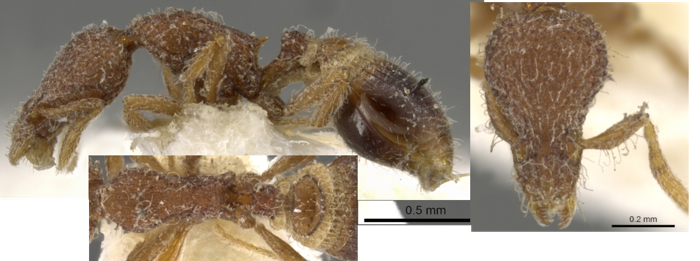 Posterior margin of clypeus
without conspicuous erect hairs; TL 2.1 mm;
orange-brown, gaster blackish-brown Posterior margin of clypeus
without conspicuous erect hairs; TL 2.1 mm;
orange-brown, gaster blackish-brown |
West Africa and Congo Basin - malaplax |
| -- | Posterior margin of clypeus with a transverse row of 4 or 6 straight erect, stout, hairs | 17 |
| 17 | 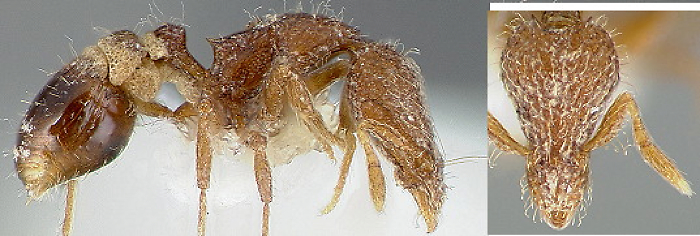 Posterior margin of
clypeus with a transverse row of 4 straight long, erect, stout, hairs Posterior margin of
clypeus with a transverse row of 4 straight long, erect, stout, hairs |
Zaïre & Burundi - piliversa |
| -- | 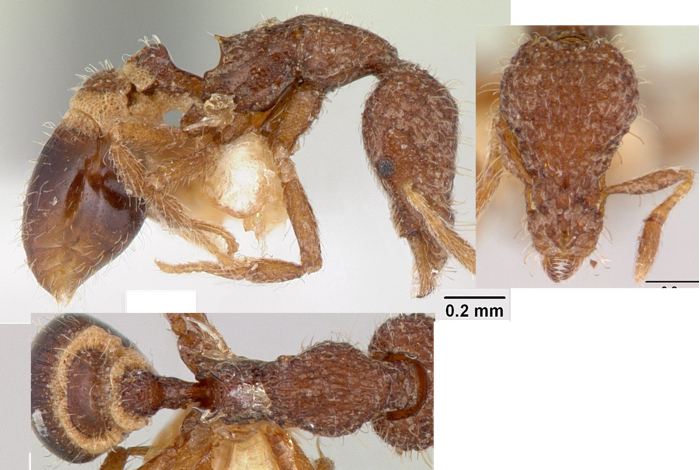 Posterior margin of clypeus with a transverse row of 6
straight shorter, erect, stout, hairs Posterior margin of clypeus with a transverse row of 6
straight shorter, erect, stout, hairs |
Burundi - bellatrix |
| 18 | 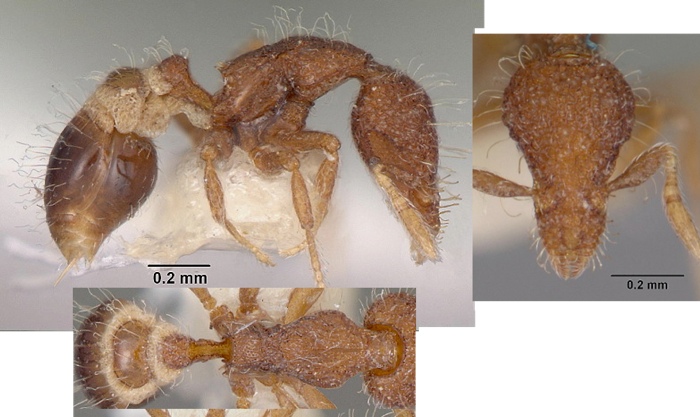 In profile the
longest hairs
on the clypeal dorsum (the rear-most row) no more than half the length
of the hairs situated on the dorsum of head just behind the level of
the eyes; TL 2.0-2.1 mm; medium-brown, gaster blackish-brown In profile the
longest hairs
on the clypeal dorsum (the rear-most row) no more than half the length
of the hairs situated on the dorsum of head just behind the level of
the eyes; TL 2.0-2.1 mm; medium-brown, gaster blackish-brown |
Cameroun - placora |
| -- | In profile both such sets of hairs of a similar length | 19 |
| 19 | 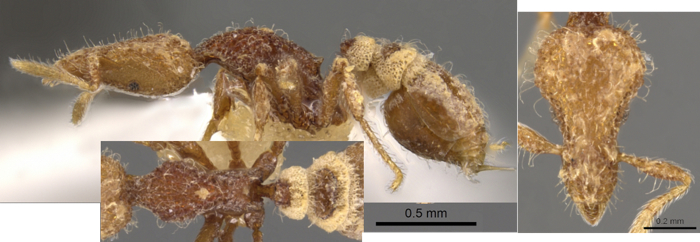 Posterior
spongiform strip of petiole very large, obviously densely spongiform
not lamellar, thickness in dorsal view greater the exposed length of
petiole node; TL 2.6-2.6 mm; dull yellowish-brown or lighter Posterior
spongiform strip of petiole very large, obviously densely spongiform
not lamellar, thickness in dorsal view greater the exposed length of
petiole node; TL 2.6-2.6 mm; dull yellowish-brown or lighter |
Cameroun - arahana |
| -- | Posterior spongiform strip of petiole narrow and lamellar, thickness clearly less than exposed length of petiole node | 20 |
| 20 | 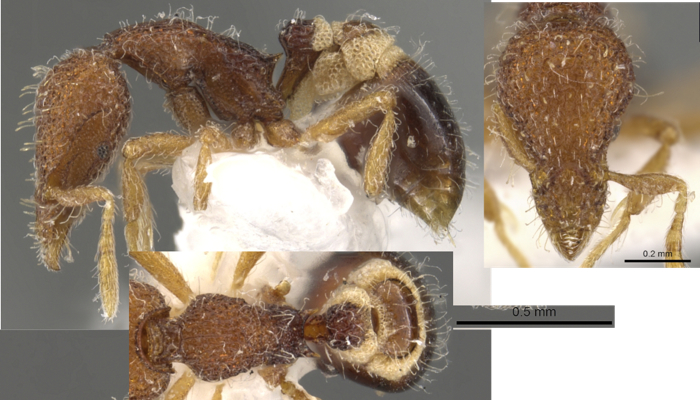 In
posterior view head with long hairs seen as distinctly swollen
apically, increasing in width from base to apex; TL 2.3 mm; medium-
brown, gaster blackish In
posterior view head with long hairs seen as distinctly swollen
apically, increasing in width from base to apex; TL 2.3 mm; medium-
brown, gaster blackish |
Angola - fenkara |
| -- | In posterior view head with long hairs of uniform width throughout their length | 21 |
| 21 | 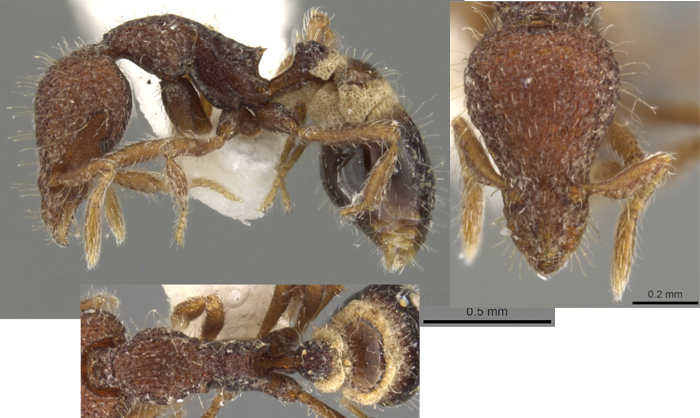 Median
indentation in posterior margin of spongiform strip of postpetiole not
reaching sclerotised portion of disc; HW 0.50; TL 2.7-2.8 mm; dark
brown, gaster blackish Median
indentation in posterior margin of spongiform strip of postpetiole not
reaching sclerotised portion of disc; HW 0.50; TL 2.7-2.8 mm; dark
brown, gaster blackish |
Gabon - synkara |
| -- | 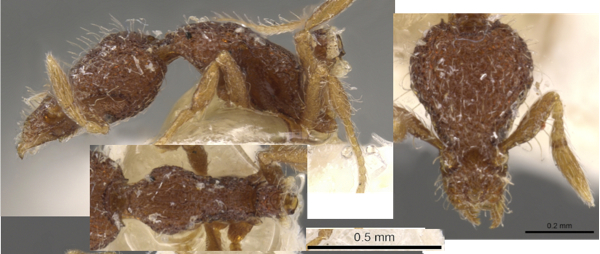 Median
indentation in posterior margin of spongiform strip of postpetiole
reaching sclerotised portion of disc; TL 2.1 mm; brown Median
indentation in posterior margin of spongiform strip of postpetiole
reaching sclerotised portion of disc; TL 2.1 mm; brown |
Cameroun - tolomyla |
|
Dorsum of pronotum smooth or densely reticulo-punctate | . |
| 22 | Anterior margin of clypeus solely with a few fine curved simple hairs; scape bearing straight hairs that project at right-angles; eye of 1-2 ommatidia and difficult to see; TL 2.2 mm, HL 0.54, HW 0.40, SL 0.27, PW 0.24 (no illustrations available) | South Africa - mira |
| -- | Scape lacking straight hairs; eye larger 4 plus ommatidia | 23 |
| 23 | Head in full face
view with a near
straight occiput and straight sides; appressed hairs variably thick but
straight sided; clypeus with spatulate hairs |
24 |
| -- | Head in full face
view variable, most with arcuate sides; appressed hairs fine or
spatulate; clypeus with filiform or clavate hairs |
25 |
| 24 | 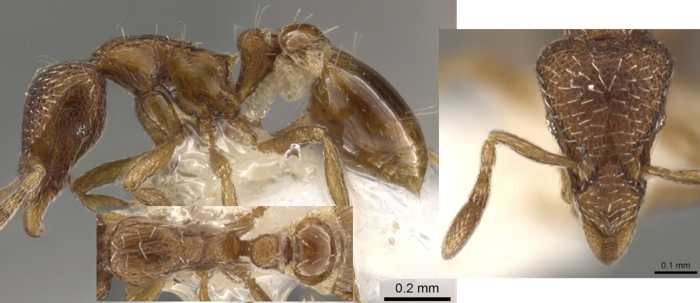 Clypeus with narrow indistinct
spatulate hairs; occipital lobe without a laterally projecting
flagellate hair; TL 1.9-2.0 mm, HL 0.47-0.51, HW 0.33-0.34, SL
0.25-0.27, PW 0.22-0.25 Clypeus with narrow indistinct
spatulate hairs; occipital lobe without a laterally projecting
flagellate hair; TL 1.9-2.0 mm, HL 0.47-0.51, HW 0.33-0.34, SL
0.25-0.27, PW 0.22-0.25 |
South Africa - agnosta |
| -- | 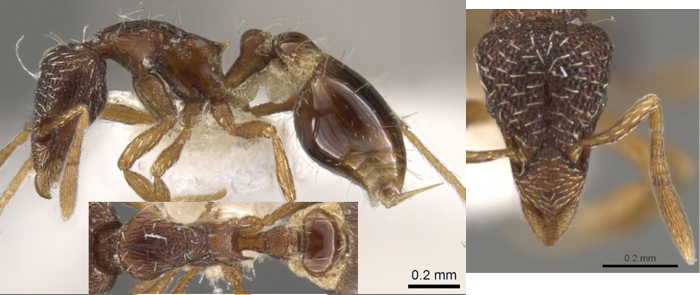 Clypeus with broad spatulate
hairs; occipital lobe with a laterally projecting flagellate hair; TL
2.1 mm, HL 0.53, HW 0.36, SL 0.27, PW 0.25 Clypeus with broad spatulate
hairs; occipital lobe with a laterally projecting flagellate hair; TL
2.1 mm, HL 0.53, HW 0.36, SL 0.27, PW 0.25 |
South Africa - dictynna |
| 25 | 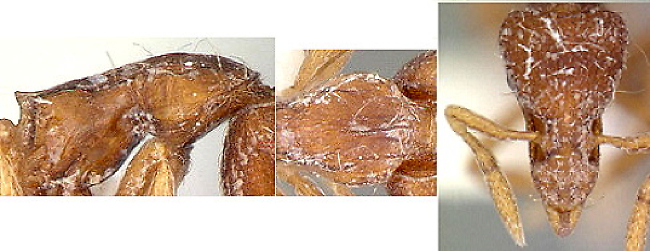 Pronotal humeri each
with a
long flagellate hair, the pronotum dorsum with a median ridge; leading
edges of scapes without anteriorly projecting long hairs; anterior
clypeal margin convex and lacking a lateral fringe of spatulate hairs Pronotal humeri each
with a
long flagellate hair, the pronotum dorsum with a median ridge; leading
edges of scapes without anteriorly projecting long hairs; anterior
clypeal margin convex and lacking a lateral fringe of spatulate hairs |
26 |
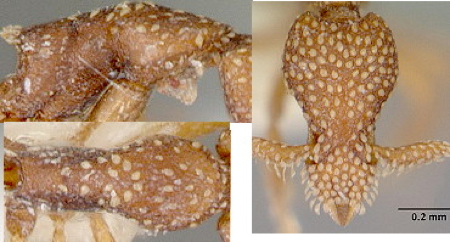 Pronotal humeri
without long
flagellate hairs, the pronotum dorsum without a median ridge; leading
edges of scapes with anteriorly projecting long hairs; anterior clypeal
margin straight to concave and with a continuous fringe of spatulate
hairs Pronotal humeri
without long
flagellate hairs, the pronotum dorsum without a median ridge; leading
edges of scapes with anteriorly projecting long hairs; anterior clypeal
margin straight to concave and with a continuous fringe of spatulate
hairs |
30 | |
| 26 | 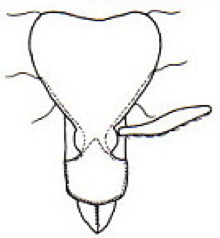 In profile clypeal
dorsum
without hairs; in full face view anterior clypeal margin broadly
convex; sides of clypeus near parallel; TL 2.1-2.3 mm; glossy light
brown In profile clypeal
dorsum
without hairs; in full face view anterior clypeal margin broadly
convex; sides of clypeus near parallel; TL 2.1-2.3 mm; glossy light
brown |
Zimbabwe - rusta |
| -- | In profile clypeal dorsum with weakly clavate posteriorly curved hairs hairs; in full face view anterior clypeal margin narrowly convex; sides of clypeus forming a line with the mandibles | 27 |
| 27 | Head in full-face
view without laterally projecting flagellate hairs |
28 |
| -- | Head in full-face view with laterally projecting flagellate hairs | 29 |
| 28 | 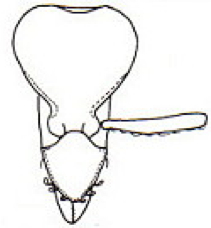 Elongated hairs on
gaster
restricted to a transverse row of four close to the base; flagellate
hairs absent from upper scrobe margins; TL 1.9 mm; dull glossy yellow Elongated hairs on
gaster
restricted to a transverse row of four close to the base; flagellate
hairs absent from upper scrobe margins; TL 1.9 mm; dull glossy yellow |
. |
| . | 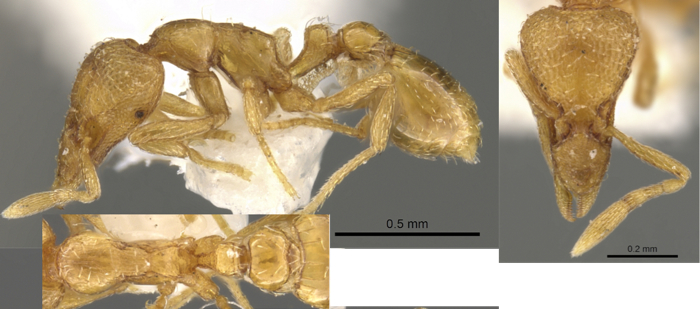 |
South Africa - anarta |
| -- | Elongated hairs on gaster numerbering 12 or more and not confined to close to the base; 2-3 flagellate hairs on each upper scrobe margin; TL 1.8-2.0 mm, HL 0.48-0.51, HW 0.32-0.35, SL 0.24-0.28, PW 0.20-0.22 (no available illustration) | South Africa - ogyga |
| 29 | 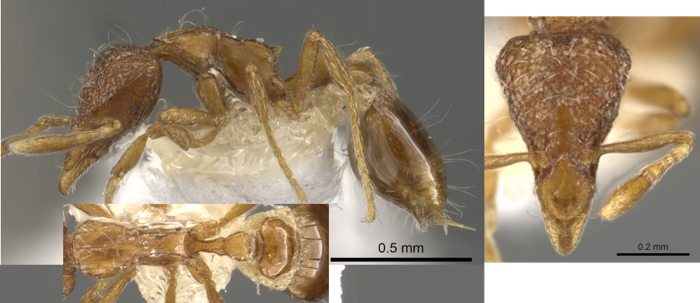 Elongated hairs on
gaster
restricted to a transverse row of four close to the base; flagellate
hairs absent from upper scrobe margins; TL 1.9 mm; dull glossy yellow Elongated hairs on
gaster
restricted to a transverse row of four close to the base; flagellate
hairs absent from upper scrobe margins; TL 1.9 mm; dull glossy yellow |
South Africa - sardonica |
| -- | 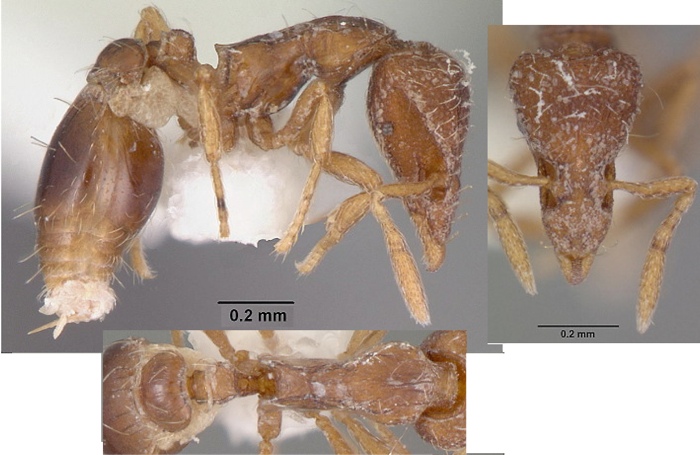 Elongated
hairs on gaster numbering 12 or more and not confined to close to the
base; 2-3 flagellate hairs on each upper scrobe margin; TL 1.9-2.1 mm;
glossy medium brown Elongated
hairs on gaster numbering 12 or more and not confined to close to the
base; 2-3 flagellate hairs on each upper scrobe margin; TL 1.9-2.1 mm;
glossy medium brown |
South Africa & Lesotho - oxysma |
| 30 | Mandibles with 16-17 teeth of which the 7th or 8th from the base is by far the largest; TL 2.5-2.6 mm; black | 31 |
| -- | Mandibles with 12 teeth of which one of the basal row of five is the largest | 32 |
| 31 | 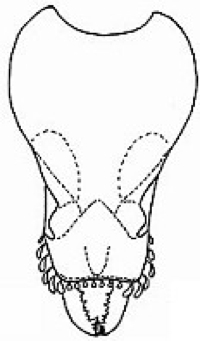 TL 2.5-2.6
mm; black TL 2.5-2.6
mm; black |
Cameroun - terroni |
| -- | TL 3.4-3.6, HW 0.66-0.68; head extremely flattened dorsoventrally; overall finely punctate-granular no images available) | Cameroun & Zaire - tethepa |
| . | Mandibles with 12 teeth of which one of the basal row of five is the largest | . |
| 32 | 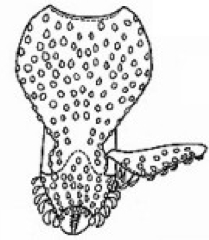 In full-face view the
head
with entire dorsum with large flattened, very broadly scale-like to
suborbicular hairs In full-face view the
head
with entire dorsum with large flattened, very broadly scale-like to
suborbicular hairs |
33 |
| -- | In full-face view head without such hairs, or if present the hairs in one or two clear transverse bands | 34 |
| 33 | 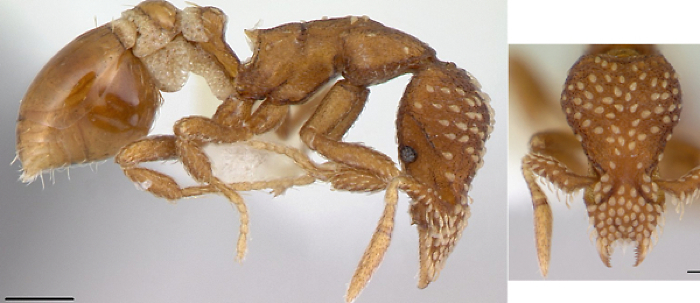 Postpetiole
and first gastral tergite with erect hairs, CI 63-67, no or few
scale-like hairs on disc of postpetiole; TL 1.9-2.1 mm; medium to light
brown Postpetiole
and first gastral tergite with erect hairs, CI 63-67, no or few
scale-like hairs on disc of postpetiole; TL 1.9-2.1 mm; medium to light
brown |
West Africa & Congo Basin - cavinasis |
| -- | 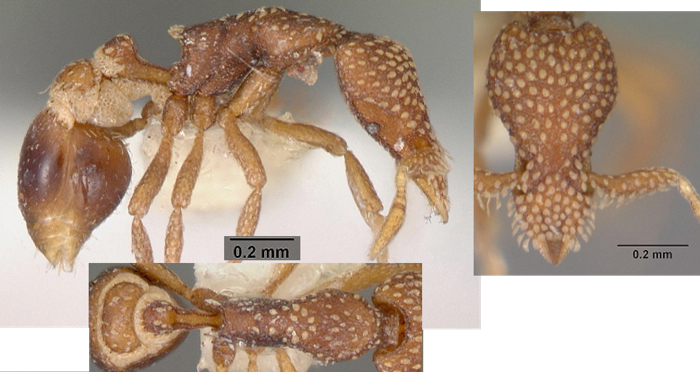 Postpetiole and first
gastral tergite without erect hairs, CI 56-63, scale-like hairs sparse
but obvious on disc of postpetiole; TL 2.0-2.2 mm; medium to dark brown Postpetiole and first
gastral tergite without erect hairs, CI 56-63, scale-like hairs sparse
but obvious on disc of postpetiole; TL 2.0-2.2 mm; medium to dark brown |
West Africa - sharra |
| 34 | First gastral tergite without standing hairs | 35 |
| -- | First gastral tergite with standing hairs numerous, or at least single basal and apical pairs | 36 |
| 35 | 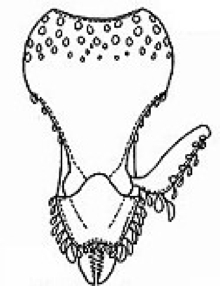 Dorsum of head with a
transverse band of broadly scale-like to suborbicular hairs just
forward of occipital margin; TL 2.1 mm Dorsum of head with a
transverse band of broadly scale-like to suborbicular hairs just
forward of occipital margin; TL 2.1 mm |
. |
| . | 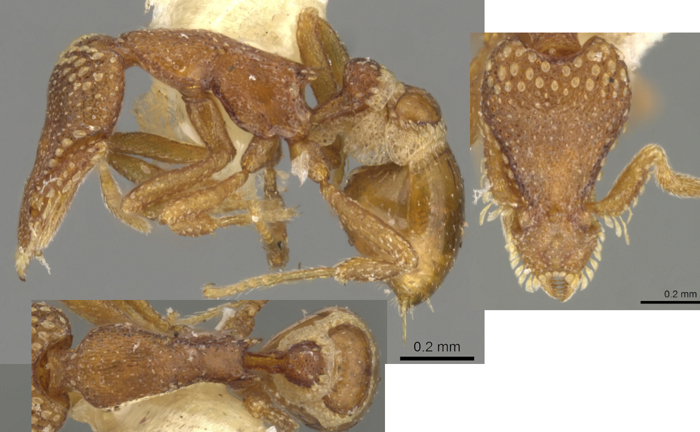 |
Ghana - chyatha |
| -- | 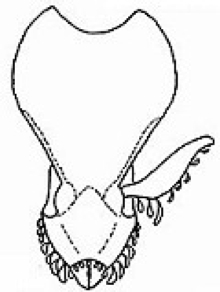 Dorsum of head
without hairs
other than fringe around clypeal margin; TL 2.1-2.2 mm; uniform light
brown Dorsum of head
without hairs
other than fringe around clypeal margin; TL 2.1-2.2 mm; uniform light
brown |
. |
| . | |
Ivory Coast - impidora |
| 36 | Base of first gastral tergite sharply impressed medially, sclerite with a dented appearance, scapes relatively long (SI 72-80); TL 2.4-2.8 mm; yellow to medium brown, gaster may be darker | 37 |
| -- | Base of first gastral tergite not impressed medially, scapes shorter (SI 58-67) | 41 |
| 37 | Mesonotum dorsum
with 3-4 pairs of straight or slightly curved erect bristle-like
simple or slightly thickened hairs |
38 |
| -- | Pronotum with and sides of head
with small spoon-shaped hairs |
40 |
| 38 | Pronotum with
erect simple hairs as on mesonotum; pronotal humerus with a single
laterally projecting elongate simple hair; dorso-lateral margin of head
behind the eye with 5-6 projecting
curved hairs that are blunt or feebly thickened; promesonotum lacking
in spoon-shaped hairs; TL 2.3 mm, HL 0.66, HW 0.41, SL
0.31, PW 0.26 - no illustrations available |
South Africa - noara |
| -- | Pronotum with and sides of head
with small spoon-shaped hairs |
39 |
| 39 | 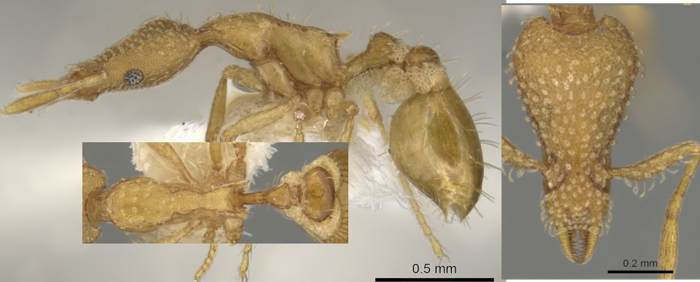 Propodeum
near smooth; simple curved erect hairs numerous on head and contrasting
with spoon-shaped ground pilosity; TL 2.3-2.5 mm, HL
0.64-0.70, HW 0.38-0.41, SL
0.30-0.32, PW 0.25-0.28 Propodeum
near smooth; simple curved erect hairs numerous on head and contrasting
with spoon-shaped ground pilosity; TL 2.3-2.5 mm, HL
0.64-0.70, HW 0.38-0.41, SL
0.30-0.32, PW 0.25-0.28 |
West Africa - exunca |
| -- | 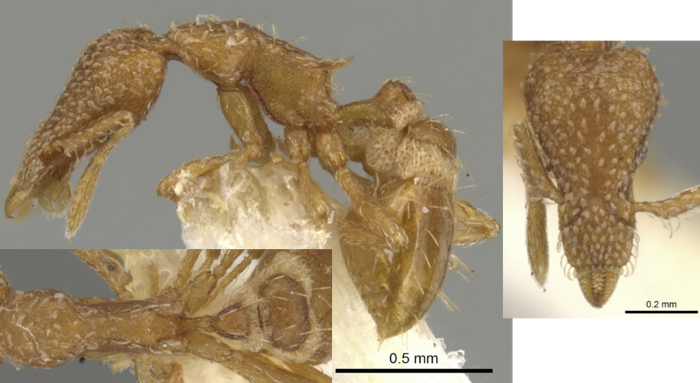 Alitrunk
generally weakly sculptured; head without erect hairs; pronotum dorsum
with solely distinct spoon-shaped
hairs; mesonotum with 3-4 pairs of long curved hairs; TL 2.3-2.5 mm, HL
0.62-0.67, HW 0.38-0.41,
SL
0.29-0.31, PW 0.24-0.2 Alitrunk
generally weakly sculptured; head without erect hairs; pronotum dorsum
with solely distinct spoon-shaped
hairs; mesonotum with 3-4 pairs of long curved hairs; TL 2.3-2.5 mm, HL
0.62-0.67, HW 0.38-0.41,
SL
0.29-0.31, PW 0.24-0.2 |
Zimbabwe & South Africa - robertsoni |
| 40 | 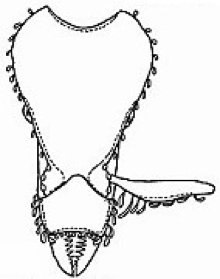 Alitrunk wholly but
variably reticulate-punctate; TL 2.4-2.8 mm, HL 0.64-0.70, HW
0.39-0.42, SL 0.29-0.32, PW 0.24-0.28 ; Alitrunk wholly but
variably reticulate-punctate; TL 2.4-2.8 mm, HL 0.64-0.70, HW
0.39-0.42, SL 0.29-0.32, PW 0.24-0.28 ; |
. |
| . | 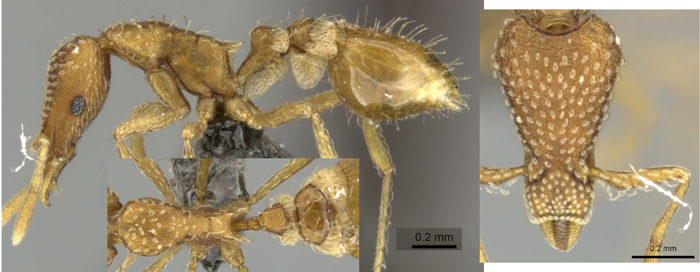 |
South Africa - emarginata |
| -- | 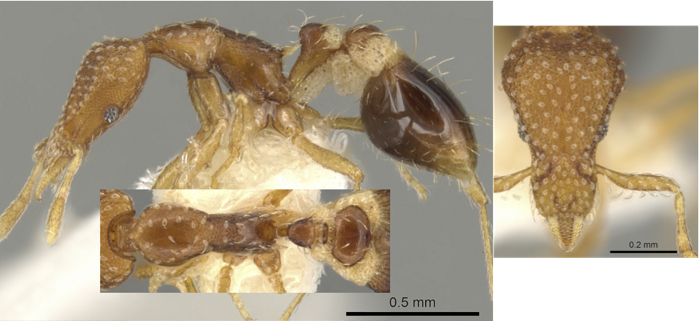 Alitrunk largely smooth and shiny; head and alitrunk
medium brown, gaster contrastingly darker brown Alitrunk largely smooth and shiny; head and alitrunk
medium brown, gaster contrastingly darker brown |
Burundi - subsessa |
| . | Base of first gastral tergite not impressed medially, scapes shorter (SI 58-67) | . |
| 41 | 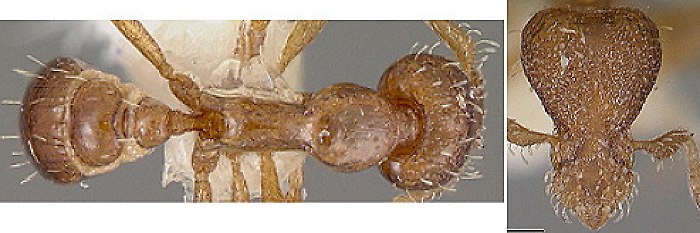 Pronotal disc glassy
smooth
between widely scattered small punctures; TL 2.2-2.3 mm; light glossy
brown Pronotal disc glassy
smooth
between widely scattered small punctures; TL 2.2-2.3 mm; light glossy
brown |
Rwanda - gatuda |
| -- | Pronotal disc uniformly closely sculptured, subopaque to opaque | 42 |
| 42 | 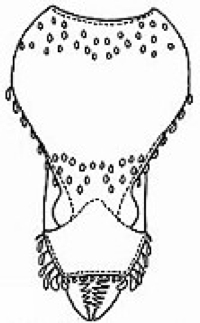 Dorsum of head with a
transverse band of broadly scale-like hairs just forward of occipital
margin plus another just behind the level of the frontal lobes; TL 2.5
mm; light brown Dorsum of head with a
transverse band of broadly scale-like hairs just forward of occipital
margin plus another just behind the level of the frontal lobes; TL 2.5
mm; light brown |
. |
| . |  |
Cameroun - behasyla |
| -- | Dorsum of head without two bands of scale-like hairs | 43 |
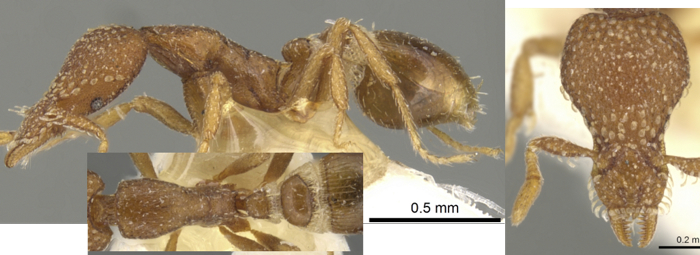
| 43 | 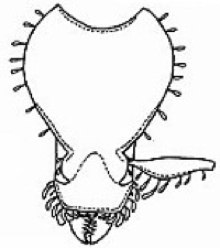 In full face view
head with
conspicuous projecting hairs behind the level of the eyes In full face view
head with
conspicuous projecting hairs behind the level of the eyes |
44 |
| -- | 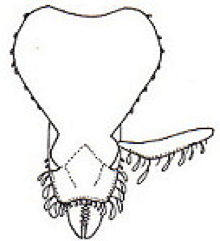 In full face view
head
without conspicuous projecting hairs behind the level of the eyes In full face view
head
without conspicuous projecting hairs behind the level of the eyes |
45 |
| 44 | 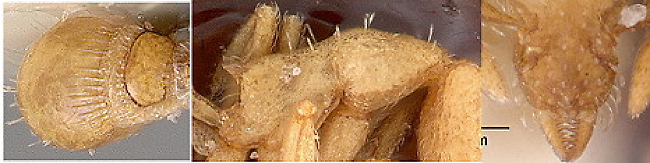 Anterior clypeal
margin
transverse; dorsal alitrunk with 6-7 pairs of erect hairs; TL 2.0-2.1
mm; uniform dull yellow Anterior clypeal
margin
transverse; dorsal alitrunk with 6-7 pairs of erect hairs; TL 2.0-2.1
mm; uniform dull yellow |
West Africa & Congo Basin - hensekta |
| -- | 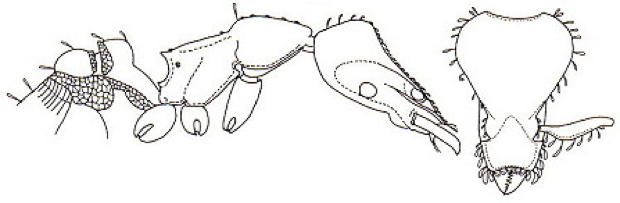 Pronotum dorsum
punctate; TL 2.4-3.0 mm; dull yellow to light yellowish-brown Pronotum dorsum
punctate; TL 2.4-3.0 mm; dull yellow to light yellowish-brown(j. syn. dendexa) |
. |
| . | 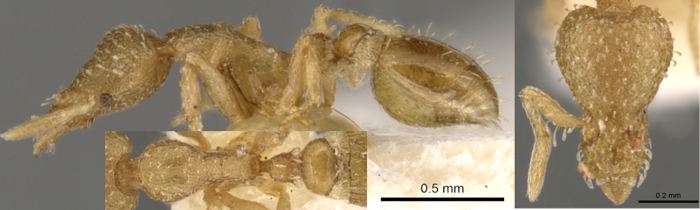 |
Cameroun to East Africa - truncatidens |
| 45 | 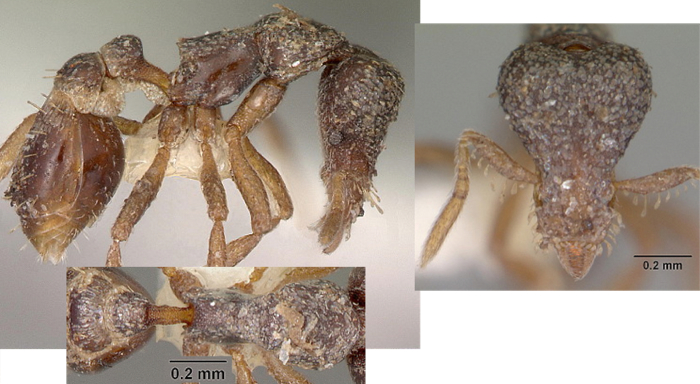 Postpetiole dorsum
finely
longitudinally costulate; infradental lamella of propodeum reduced to a
simple flange; TL 2.6-2.7 mm; dark brown Postpetiole dorsum
finely
longitudinally costulate; infradental lamella of propodeum reduced to a
simple flange; TL 2.6-2.7 mm; dark brown |
Rwanda - datissa |
| -- | 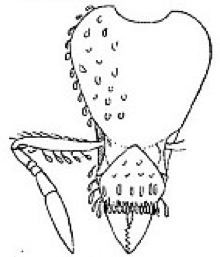 Postpetiole dorsum
wholly
smooth; infradental lamella of propodeum broad and conspicuous; basal
lamella of mandible an evenly rounded broad lobe; TL 2.2-2.4 mm; dark
brown to blackish-brown Postpetiole dorsum
wholly
smooth; infradental lamella of propodeum broad and conspicuous; basal
lamella of mandible an evenly rounded broad lobe; TL 2.2-2.4 mm; dark
brown to blackish-brown |
. |
| . | 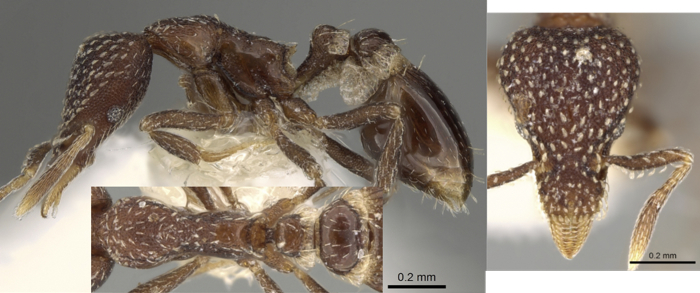 |
South Africa - transversa |
 |
MYRMICINAE Introduction |
© 2007, 2013, 2015 - Brian Taylor CBiol FSB FRES 11, Grazingfield, Wilford, Nottingham, NG11 7FN, U.K. |
href="smithistruma.htm"